
By Jim MacMillan, REI Systems
Federal agencies do not need more consulting shelfware. A government-wide review tied to the April 30, 2026 Executive Order on procurement reform found roughly $120 billion obligated on cost-reimbursement consulting in fiscal 2024 alone, a model that pays for effort, not measurable progress. The EO now pushes agencies toward fixed-price, outcome-based work.
That shift is overdue. But for advisory services, it will only work if agencies answer one question before award: what counts as a measurable outcome? Without that clarity, outcome-based contracting can recreate the same problems under a new label: failed implementations, wasted spend, repeat OIG and GAO findings, and contracts that end in disputes instead of results.
Across decades of federal advisory work, REI Systems has seen three mistakes undermine outcome-based models:
- Calling a deliverable an outcome
- Starting without a baseline
- Waiting until acceptance to decide who caused the result
When that happens, the contract may look outcome-based at award but behave like a traditional effort-based model during execution.
Defining a measurable outcome comes down to three checks, all settled before award: What does the contractor actually control? How will success be verified? And what happens if the outcome is only partially achieved?
Together, these checks form a practical readiness test. If a requirement clears all three, it may be ready for outcome-based contracting. If it does not, agencies should pause. They may not be buying an outcome at all. They may be buying a deliverable in disguise.
What does the contractor actually control?
In consulting work, contractors control outputs that enable outcomes: assessments, recommendations, designs, plans, and models. The agency often controls whether those outputs are adopted, funded, implemented, and sustained.
That split should shape pricing. REI’s Accountability Pricing Stack separates payment into three layers: a base price for contractor-controlled outputs, a performance holdback for verified outcomes, and an incentive for results above target.
- Base: fixed price for outputs the contractor controls
- Performance: holdback released when outcomes are verified
- Incentive: upside for results that exceed targets
The holdback should scale with controllability: the more of the result the contractor controls, the larger the performance layer can be.
Transferring risk beyond what a contractor controls doesn’t buy accountability. It buys higher bids and fewer bidders.
How will success be verified?
An outcome is contract-ready only when both parties know what evidence will prove it was achieved: the metric, baseline, data source, measurement window, and verification method, all defined before work begins.
Verification rigor should match the evidence the outcome generates. Some results can be validated independently, such as audit-finding closure or certifications. Others are measured through government systems of record: cycle times, backlog levels, or training completion.
In Practice: A Recent REI GSA Engagement
In a recent GSA advisory engagement, REI used a structure that separated payment for accepted outputs from payment for verified outcomes. Milestone payments covered the analysis and deliverables REI controlled. A 20 percent holdback was released after validation, and a 10 percent incentive was tied to verified cost reductions.
The lesson: outcome-based pricing works best when the measurement window and payment trigger match when the outcome can realistically be verified.
The harder cases, such as strategy adoption, organizational change, and leadership alignment, have no natural independent verifier, which is why outcome-based models tend to exclude them. But exclusion is a choice, not a necessity. With a structured acceptance protocol defined at award, the evidence can be named upfront: use in leadership decisions, validated pre/post surveys, or sustained adoption of new processes across offices.
Looking ahead, AI may also expand what agencies can verify by helping identify adoption signals in unstructured data, but those signals should be tied to targets defined at award, not used as after-the-fact justification.
What happens if the outcome is partially achieved?
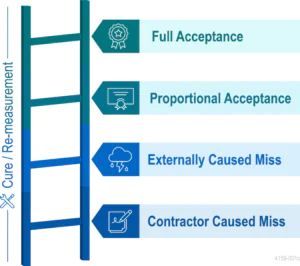
REI’s Outcome Acceptance Ladder
Consulting outcomes rarely succeed or fail in a simple pass/fail way. A backlog may shrink short of target, or adoption may take hold in one office and lag in another. Contracts should define partial achievement before work begins.
REI’s Outcome Acceptance Ladder sets each outcome and its payment rule at award, from full delivery at the top down to a complete miss at the bottom. A shortfall that can still be fixed first runs through a cure period and is re-measured before any rung is final. The key is attribution. If a target is missed, the contract should already explain how the parties will determine whether the cause was contractor performance, agency action, or external conditions.
Getting the foundation right
Contracting officers and program offices weigh different priorities: contained risk and defensible terms for one, mission results for the other. Aligning accountability to control serves both: a defensible, competitive deal for the officer, and real outcomes for the program office. But it only works if accountability is defined at award. Without that, agreements that look outcome-based on paper behave like cost-reimbursement contracts in execution.
Together, these three checks form the foundation of REI’s Outcome Assurance Framework: map control, name the evidence, price accordingly, and define acceptance before award.
Before agencies buy outcomes, they need to know whether the requirement is ready for outcome-based contracting. When they do, contracts can focus on what matters most: measurable progress that lasts.