
Chetan Rane, REI Systems & Manjit Singh, President, Agilious and Managing Partner, AgilisTEK (a Joint Venture consisting of Agilious and REI Systems)
Digital transformation is now a priority across federal agencies, but too often, it is defined by what technology is deployed rather than what mission outcomes are achieved. The result is familiar: systems with far more capabilities than users need, interfaces that feel cluttered, and long-term costs driven by features that add little value.
A simple analogy helps illustrate the issue. Think about a TV remote with 30 or more buttons. Most people use only a handful, commonly 5 buttons – power, channel up/down, and volume up/down. Unfortunately, many Government systems frequently follow the same pattern of a 30 button TV remote, designed for every conceivable scenario rather than the few that matter most.
These insights emerged clearly during a recent joint discussion between REI Systems and Agilious digital-transformation subject-matter experts, as they reflected on decades of experience supporting federal modernization efforts.
Digital Transformation Is Not a Platform Upgrade
One of the most persistent misconceptions in government is equating digital transformation with technology modernization alone. Moving to the cloud, adopting low-code platforms, or replacing legacy systems is often labeled “transformation,” even when the underlying processes remain unchanged. This is akin to someone who is a bad driver, upgrading their car to a high-cost, luxury brand auto, while continuing to maintain their bad driving habits.
True digital transformation starts elsewhere: with mission outcomes.
As Chetan Rane of REI Systems noted during the discussion,
“We often lead with a platform or a specific technology and call that digital transformation. But upgrading technology alone doesn’t guarantee better outcomes. The successful efforts always start by defining what the mission actually needs to achieve, and then using technology to enable that.”
The right question is not, “What technology should we buy?” but rather, “What are we trying to accomplish that we cannot do today?” Whether the goal is faster inspections, improved constituent service, or reduced processing time, clarity on outcomes ensures that technology becomes a means, not the goal itself.
Industry leaders understand this distinction well. Commercial products succeed by narrowing focus, delivering value quickly, and expanding only after demand is proven. Government can adopt this mindset without sacrificing accountability, compliance, or oversight.
Focus on the “Five Buttons” That Matter
Federal programs operate within rigid funding and procurement cycles, which can unintentionally encourage over-scoping. Agencies often request broad functionality up front to avoid future funding risk. Once a contract is awarded, there is little incentive to remove features, even when evidence shows they are not needed, or are not being used.
Over time, these decisions accumulate. Feature bloat increases maintenance costs, can complicate modernization, and often makes systems harder to use.
During the discussion, Manjit Singh of Agilious summarized this challenge succinctly:
“In government, unfocused scope becomes permanent cost. Every unnecessary feature adds long-term operational risk.”
A more effective approach is to identify the small set of capabilities, the “five buttons” that directly support mission outcomes. Most users rely on only a fraction of system functionality. Designing around those core workflows improves adoption, reduces training burden, and accelerates delivery.
Simplicity as a Design Constraint
One effective mindset shift is treating simplicity as a design constraint, not a technical limitation. Instead of asking, “What else can we add?” teams ask, “What can we remove without harming outcomes?”
As Steve Jobs said:
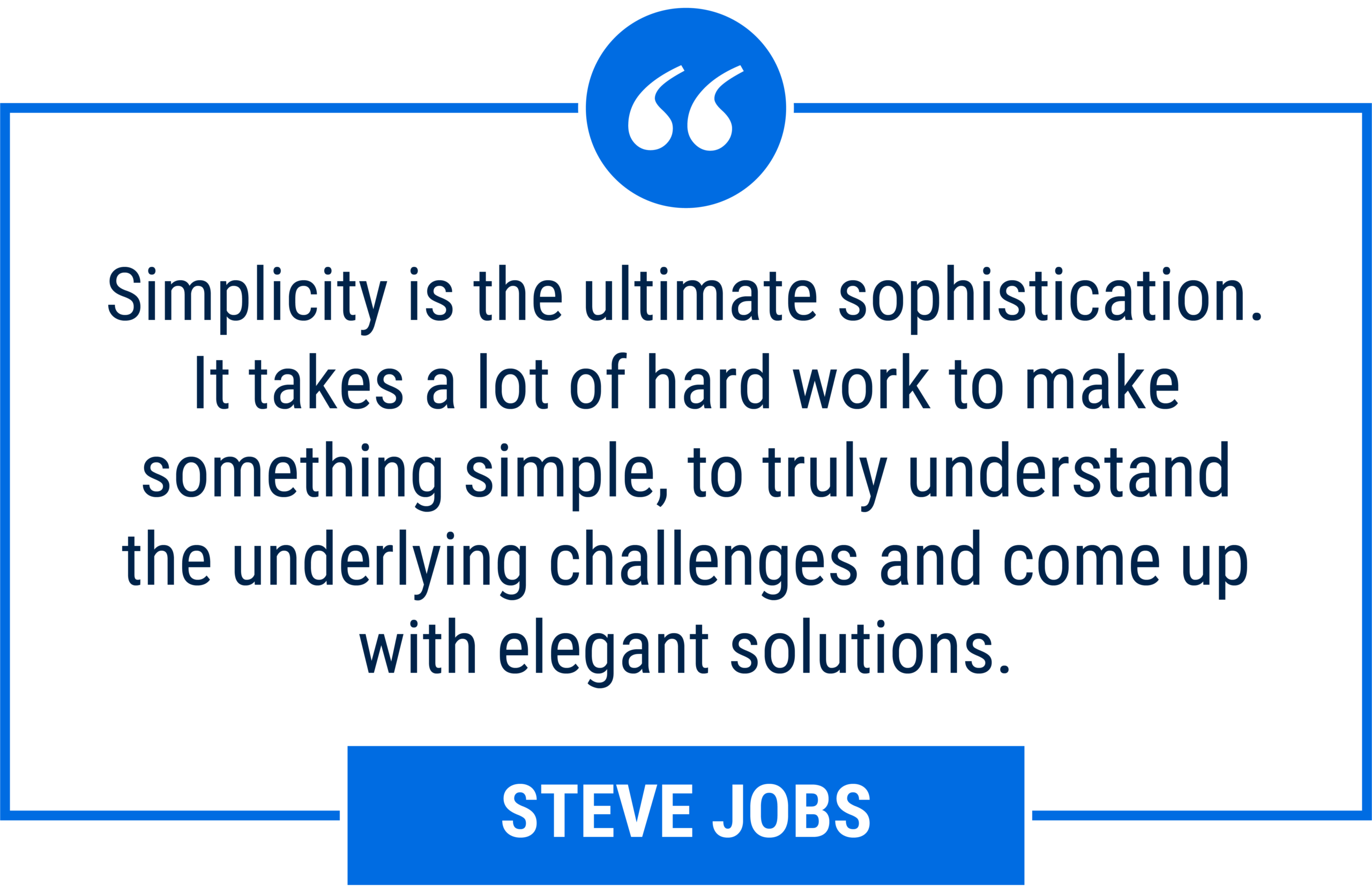
This approach reduces feature bloat, accelerates delivery, and lowers long-term operations and maintenance costs. It also produces systems that are easier to train on and easier to evolve.
Incremental delivery plays a critical role here. When functionality is introduced in small, validated pieces, agencies can observe real usage before committing additional resources. If demand materializes, the capability can be added in a future iteration. If it does not, no long-term cost is incurred.
Proof in Practice: NASA’s Innovation Submission Modernization
REI Systems’ work modernizing NASA’s innovation submission process illustrates how disciplined scoping and user focus translate into real results. Rather than simply replacing a legacy platform, the effort centered on how innovators and small businesses actually interacted with the system.
By engaging users early, simplifying workflows, and prioritizing high-value capabilities, NASA achieved measurable improvements in performance, reduced incomplete submissions, and lowered ongoing operational costs, demonstrating that less functionality, when aligned to outcomes, can deliver more value.
Proof in Practice: State Department Legacy DIS Application Modernization
Agilious modernized the DIS Application in 10 months by doing a deep dive in to the business processes and workflows that generated the large volume of reporting data from over 80 offices globally. Our focus on understanding the “why” behind the current state resulted in leaner business processes and a simplified workflow.
Start With the Why—Then Work Backward
Perhaps the most important lesson for government digital transformation is the need to slow down before speeding up. Defining the right problem is far more valuable than rushing to a solution.
When agencies clearly articulate what success looks like five or ten years from now, technology decisions become clearer, scope becomes more disciplined, and investments align with real needs. Modernizing a system without modernizing the process simply recreates old bottlenecks in a new interface.
Digital tools should remove friction, not add to it.
The Executive Takeaway
Government does not need more buttons, it needs better focus. By starting with mission outcomes, treating simplicity as a design constraint, and delivering capabilities incrementally, agencies can achieve digital transformation that is effective, sustainable, and defensible.
AgilisTEK, with the expertise of REI Systems and Agilious partner with federal leaders to bring industry discipline into government realities—helping agencies build the right solutions, at the right scale, for the right outcomes.
If you are planning your next modernization effort, ask first:
Have we clearly defined what success looks like—and are we building only what we truly need today?