
Background:

The U.S. General Services Administration (GSA) supports millions of vendors, grantees, and federal employees through the Integrated Award Environment (IAE). FSD.gov (FSD), the Federal Service Desk, provides critical support for SAM. gov and other federal award systems. As demand for reliable digital services increased, GSA recognized that the existing FSD operating model limited the agency’s ability to scale, adapt, and improve service delivery.
Previously, FSD.gov operated in a vendormanaged ServiceNow SaaS environment, which limited GSA’s control over the ServiceNow platform. This model required external support for minor updates and offered limited insight into system performance and data. Increasing operational costs, slow enhancements, and restricted governance made it difficult for GSA to meet expectations for service quality, transparency, and accessibility. To resolve these issues, GSA partnered with REI Systems to migrate FSD to a GSA-owned ServiceNow instance, creating a foundation for long-term modernization.
Challenge:
The vendor-managed operating model imposed structural constraints that limited GSA’s ability to operate and improve a mission-critical system. Even minor enhancements, such as adding incident category dropdowns or addressing Section 508 compliance, required  excessive time and cost. Meanwhile, operational and maintenance expenses rose as incident volumes stayed high, and performance improvements lagged. Limited access to ServiceNow platform data and reduced visibility into system behavior further restricted GSA’s ability to make informed decisions and plan proactively.
These limitations directly affected both frontline teams and the customers they served. Support staff managed ongoing incident volumes with limited tools and insight, while users faced slower response times and inconsistent service. Together, these challenges reduced operational agility, hindered innovation, and increased financial pressure as federal agencies were expected to improve digital service delivery while controlling costs.
Solution:
REI Systems partnered with GSA to modernize FSD.gov, aiming to address challenges in ServiceNow platform control, rising costs, and limited agility. The project transitioned FSD.gov to a GSA-owned ServiceNow instance and established a more flexible, sustainable operating model.
REI rebuilt the FSD.gov ServiceNow platform from the ground up, prioritizing speed, stability, and service continuity. The Minimum Viable Product was delivered with zero P1 or P2 defects and achieved Authority to Operate in eight weeks, approximately half of GSA’s typical 16-week approval timeline. This rapid deployment reduced operational risk and enabled GSA to quickly stabilize a system critical to federal acquisition and grants. Early stability and a modern operating model allowed GSA to shift from platform maintenance to enhancing service delivery across the federal award ecosystem.
After establishing the core ServiceNow platform, REI strengthened daily operations by implementing incident, change, and knowledge management capabilities within weeks. These enhancements created more consistent and efficient support workflows. Real-time ServiceNow dashboards and automated reporting provided actionable insights, enabling GSA teams to monitor performance closely and respond proactively.
Automation and user experience enhancements were introduced to sustain and scale improvements in service delivery, directly supporting the reliability, efficiency, and cost reductions observed after launch, including:
- ServiceNow Knowledge Management and Automated Approvals: Improved accuracy and reduced manual delays in routine support workflows, supporting faster and more predictable request handling.
- Centralized Incident Management: Enabled more consistent incident handling and resolution, contributing to improved service reliability.
- Omnichannel Support and ServiceNow Virtual Agent: Expanded self-service for routine requests, reducing manual ticket creation and supporting lower Tier 1 support demand.
- Process Mining and Targeted Communications through Engagement Messenger: Increased transparency and coordination across SAM.gov, helping GSA better manage demand and communicate effectively with users.
Together, these enhancements established the operational foundation that enabled measurable reductions in incident volume, improved system performance, and sustained cost savings described in the Results section. As a result, FSD.gov shifted from a constrained, vendor-managed system to a platform GSA can actively operate, enhance, and evolve to support its mission.
Results:
After launch, GSA observed measurable improvements in service reliability and operational efficiency across FSD.gov, directly supporting its mission to provide dependable support for federal award systems used by agencies, vendors, and federal employees.
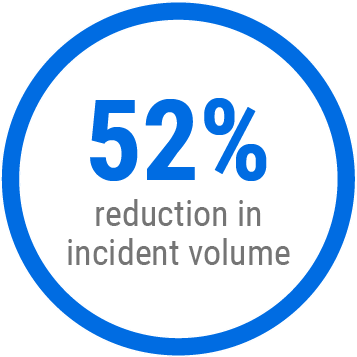
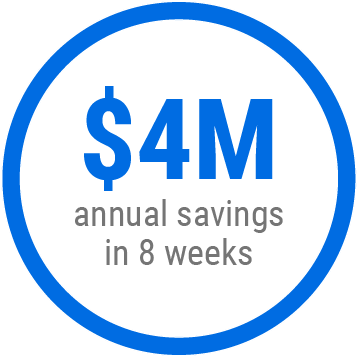
Incident volume dropped by 52 percent year over year, from 203,588 to 97,218. This reduction generated approximately $650,000 in cost savings within the first two months and is projected to yield $4 million in annual savings. Beyond cost savings, fewer incidents improved the predictability and consistency of support services, which are essential to agencies and award recipients.
Automation was central to these results. The Virtual Agent resolved 61,000 user interactions without creating tickets, significantly reducing demand on Tier 1 support. By automating routine requests, support teams could focus on more complex, mission-critical issues, strengthening operational efficiency and service quality.
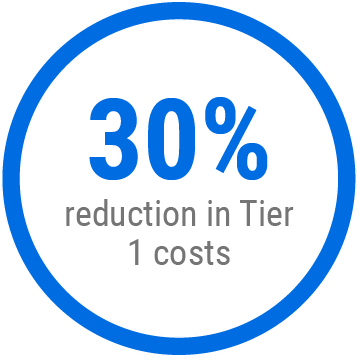
System performance improvements further enhanced the user experience. Page load times decreased by over 50 percent, enabling faster access to information and support for users across the federal award community. Targeted modernization strategies also reduced Tier 1 support costs by 30 percent, improving efficiency while maintaining service levels as demand grew.
These results demonstrate how platform ownership, automation, and disciplined delivery improve service performance, reduce operational costs, and increase system reliability.
Future State:
With a modern, GSA-owned foundation in place, FSD.gov’s focus has shifted from stabilization to continuous improvement. GSA and REI Systems are now targeting areas with the greatest operational impact, especially Tier 1 and Tier 2 Enterprise Vendor Support (EVS) incidents, which account for over 75 percent of total operational costs.
 Future enhancements aim to further reduce incident creation and improve consistency and accuracy in support operations. Planned initiatives include standardized data fields for automated categorization and routing, and additional training for Tier 1 agents to ensure structured, consistent incident logging.
To support end-to-end automation, standardized resolution codes are being implemented to enable more efficient ticket closure and data analysis. Expanded automation across EVS processes and supporting databases will help identify and implement further cost-reduction opportunities while maintaining service quality. These efforts also establish the data structure and process discipline required to support AI-enabled service operations over time.
Each six-to-nine-month development cycle is expected to deliver an additional $2–3 million in annual savings, reinforcing a model of continuous, measurable improvement. As automation maturity increases, GSA can incrementally introduce AI-enabled capabilities to further optimize routing, resolution, and demand management while maintaining human oversight. The primary objective is to leverage automation and AI-enabled service operations to reduce operational costs while enhancing the digital experience for service agents and the public.
By owning the ServiceNow platform and continuing to evolve its capabilities, GSA is positioned to deliver scalable, resilient, and user-focused services that reliably support federal acquisition, grants management, and the agencies and stakeholders who depend on them.
Copyright © 2026 REI Systems. All rights reserved.